h1>Finding a Willowdale Dentist: What to Know Before You Book
Choosing a Willowdale dentist usually comes down to three things: whether the practice covers everything your household needs without referring you elsewhere, whether you can actually get an appointment at a time that works, and whether they catch problems early rather than finding them when something hurts. The Yonge corridor through Willowdale is dense and well served, so availability isn’t the constraint. Fit is. Novus Dentistry is a general, cosmetic, and restorative practice in North York treating patients of all ages.
Here’s what’s worth thinking about before you book anything.
What should routine dental care actually involve?
Most of dentistry is unglamorous and preventive, and that’s the part that determines how much of the expensive work you end up needing later.
A routine visit means an examination of the teeth, gums, and soft tissues, a cleaning to remove what brushing and flossing can’t, and imaging where something can’t be assessed by looking at it. Gum measurements get recorded and tracked over time, which is how early gum disease gets caught — the changes are measurable well before they’re noticeable.
The cleaning matters more than people assume. Once plaque hardens into tartar, home care can’t shift it, and tartar is what sustains the inflammation that eventually costs people teeth. Our page on dental examinations covers what a visit involves, and preventive care and gum treatments goes into the gum health side.
How often should you be going?
Twice a year is the common default, and for a lot of people it’s about right.
It isn’t universal, though. People who build tartar quickly, who smoke, who have a history of gum disease, or who are managing diabetes are often better served by more frequent cleanings. People with consistently healthy gums and low decay risk are sometimes fine with less. The interval should come out of what your mouth actually does, not out of a default.
What doesn’t work is going only when something hurts. Dental pain is a late signal. Decay and gum disease both progress quietly for a long time before they announce themselves, and by the time they do, the cheap intervention window has usually closed. The Canadian Dental Association publishes general guidance on routine care if you want a neutral reference point.
What should a practice cover under one roof?
The fewer referrals out, the less coordination lands on you.
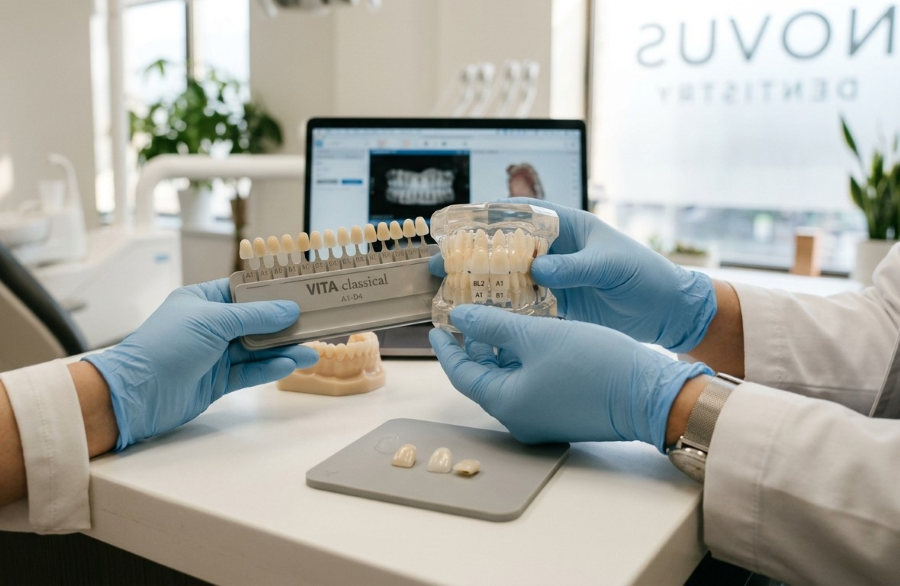
A general practice handles examinations, cleanings, fillings, and gum health. Beyond that, most households eventually need something restorative — a crown, a bridge, an implant — and often something cosmetic, whether that’s whitening, bonding, or veneers. Our general and family dentistry and cosmetic dentistry pages set out what each includes.
Two things worth asking about specifically, because they vary between practices:
Implants. Some practices restore implants but refer the surgical placement out to an oral surgeon, which means two offices and a handover. At Novus, placement is handled in-house.
Orthodontics. Clear aligner treatment has become common in general practices rather than only specialist offices. Our Invisalign page explains how that works.
Does it work for the whole household?
If you have children, a practice that treats all ages saves running two sets of appointments in two locations, and that convenience is what keeps everyone actually attending.
Treating young children is a genuinely different skill. First visits are deliberately low-key — a look, a count, a polish — and the measure of success is that the child leaves willing to come back. Habits get corrected gently rather than lectured about. Our children’s dentistry page covers the younger end.
At the other end, older adults tend to need more monitoring of existing restorations, gum recession, and dry mouth from medications. A practice used to the full age range handles both without you thinking about it.
What happens when something goes wrong?
Ask before you need to know, because dental emergencies are never convenient.
A cracked tooth on a Saturday, sudden swelling, a crown that comes off the night before a flight. What matters is whether the practice has a route for seeing you quickly. Ask what happens outside regular hours and whether existing patients get priority.
It’s worth knowing the difference between something that genuinely can’t wait — significant swelling, a knocked-out tooth, uncontrolled bleeding — and something uncomfortable that can be seen in a day or two. If you can’t tell which you’re dealing with, phone and ask rather than guessing. Our emergency dental care page covers how we handle it.
Booking with Novus Dentistry
If you’re looking for a Willowdale dentist and want to know whether we’re a sensible fit, a conversation is a better first step than a booking. You can meet our dentists or get in touch with questions about what a treatment plan would involve and how many appointments it would realistically take.